




A memorial begins with a person, not a template
When a family asks me how to customize a marble headstone, I do not begin by asking them to pick a model. I begin by asking whom we are remembering and what they want someone to feel when they approach the grave. As a marble factory professional, I know that a carved figure, a name, and a base have to work together—not just look good separately in a photograph.
Here is the order I recommend: tell us the story and check the cemetery rules; choose a form that can hold both carving and text; settle the sculptural details; select the marble while laying out the inscription; approve the complete design; then coordinate packing, delivery, and installation. At each step, I explain what your family should provide and what should be confirmed before we move on.
Step 1. Tell us whom the memorial should remember
What I ask you to provide: The person’s name, the dates and wording you are considering, any faith or cultural elements you want represented, and one or two details that genuinely remind you of them. A flower they loved, a familiar gesture, or a particular sense of calm may tell me more than a long list of decorative motifs.
I then ask how the memorial should feel: dignified and restrained, quiet and contemplative, or expressive through a carved figure. If relatives have different ideas, agree on the essential message first. We can refine a pose later; we cannot design well around an unresolved brief.
Before I suggest a shape, I also ask for the cemetery’s written rules. Please check permitted height, width, depth, materials, sculptural forms, inscription rules, foundation requirements, and who is allowed to install the stone. I would rather adjust a drawing now than discover after carving that the cemetery will not accept it.
Before we move on: We need a short, agreed memorial brief and the cemetery’s current requirements. The inscription wording can still be refined in Step 4, but its approximate length matters now.
Step 2. Choose a form that gives the carving and words room
With the site limits in hand, I compare three ways to build the tribute. For a straightforward inscription, an upright headstone gives the name and epitaph a clear central field, with room for a modest carved border or motif. A relief-carved headstone can add depth to a flower or figure without making it fully three-dimensional. A sculptural monument puts a figure beside or above a plaque; it needs more careful checks of side depth, base size, and viewing angle.
I do not choose the most elaborate form simply because it allows more carving. I sketch where the eye will go first, where the text will sit, and whether the figure still feels in proportion when viewed from the side. Our angel beside an oval plaque is a useful example: the figure has space to be expressive, while the oval remains available for an inscription. If a cross matters to your family, our angel and cross memorial suggests another arrangement—not a symbol I would add without asking.
Before we move on: Choose a form and identify the intended text area. Confirm that its overall footprint can fit the cemetery-approved space; do not select a sculpture while leaving the inscription to be squeezed in afterward.
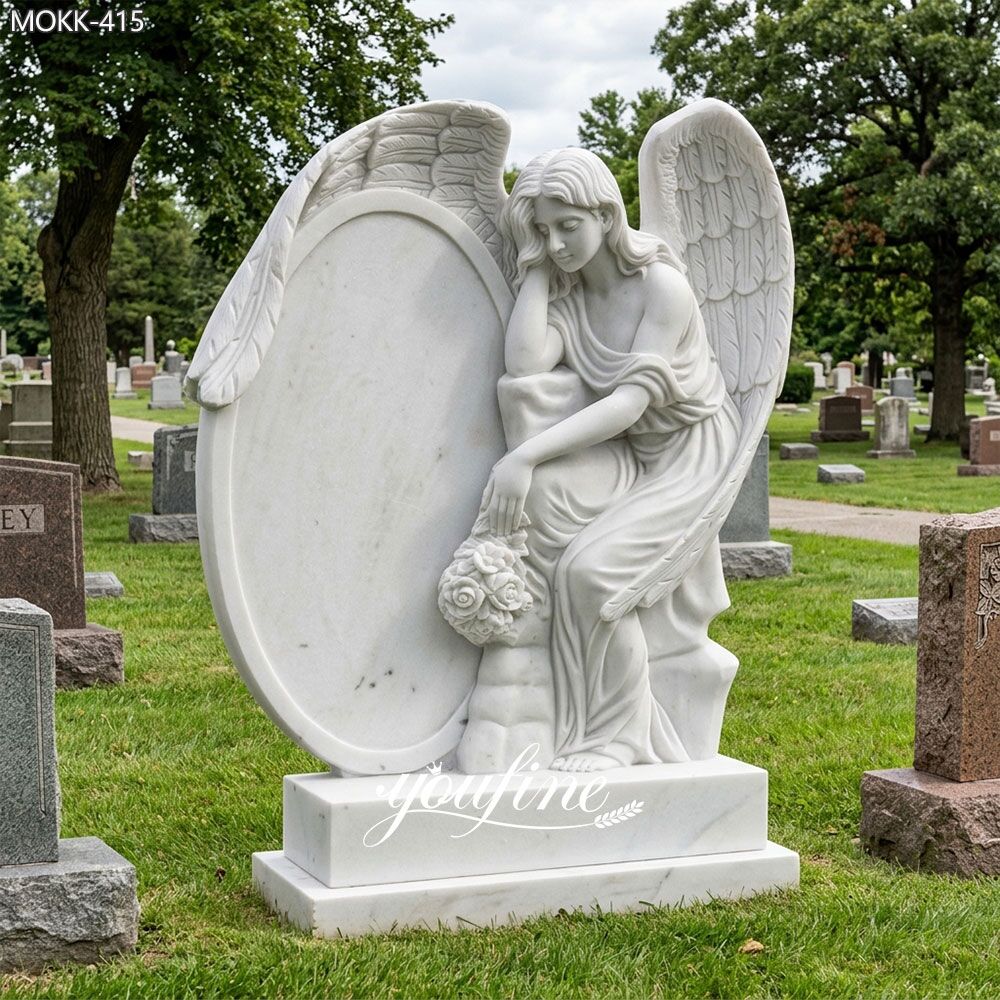
Bu YouFine mələk başdaşı, I would discuss the figure and the empty oval as one composition—not treat the inscription as an afterthought.
Step 3. Specify the carving details that make it personal
What I ask you to provide: Images that show the pose, expression, clothing, flower, or other detail you actually want. Tell me what you like in each image. A single photo labelled “something like this” leaves too much open to interpretation, especially for a face.
In hand carving, a lowered gaze, the angle of a hand, and the folds of a robe can change the mood of the piece. Look at the oval-plaque angel: the face, feathered wings, drapery, and roses do different jobs. I would ask whether your family wants that contemplative expression and floral detail, rather than assuming every angel should look the same. This is where carved depth offers something different from a flat inscription, but more detail is useful only when it serves the person being remembered.
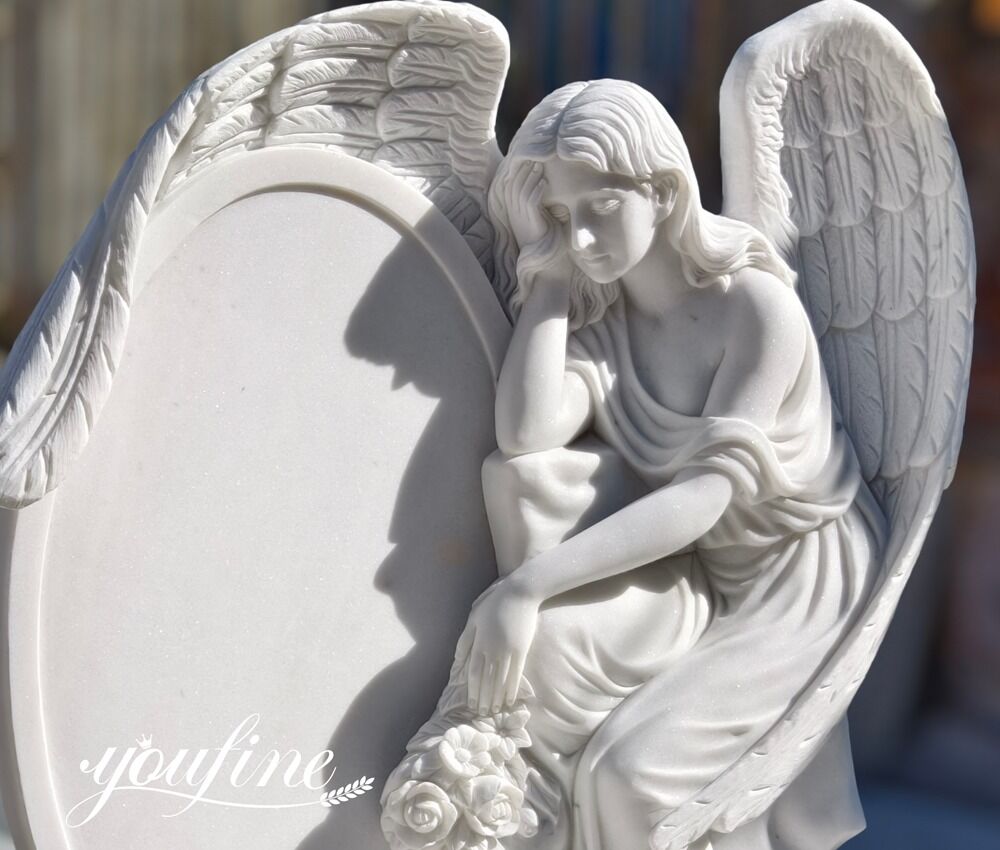
When reviewing a proposal, I would use this detal görünüşü to ask exactly which expression, folds, feathers, and flowers you want retained or changed.
Our collection also shows Jesus leaning on a column və a Virgin Mary monument. The latter has a marble figure and a granite base, not an all-marble construction. I present these as references only when a family asks for that imagery. A cross, angel, Jesus, or Mary should express a family’s own beliefs; none is a default addition.
For a portrait of the person, I ask for several clear photographs from useful angles. At the proposed scale, some facial details may need to be simplified to read well in stone. Rather than promise an exact likeness from one image, I would identify the most important features for the family to approve.
Before we move on: Agree on the subject, pose, expression, and a short list of essential details. Mark which references are inspirations and which features must be followed.
Step 4. Choose the marble while laying out the inscription
What I ask you to provide: The final proposed names, dates, epitaph, language, punctuation, and any text that must appear exactly as written. I also need to know where the memorial will stand, because the site’s exposure affects material and care decisions.
I would review stone color and veining alongside the lettering layout—not in a separate conversation after the carving has been designed. A strongly veined area might look beautiful around a figure yet make small lettering harder to read. Ask for images of the proposed stone or representative samples, then check whether the inscription has enough clear, quiet space at the intended size. If another name or date may need to be added in the future, allow for it in the layout now and ask whether later work will be possible.
Marble can weather outdoors. Sun, rainfall, nearby trees, airborne deposits, and freeze–thaw conditions may affect its appearance over time, so I would discuss the actual stone and finish with the site’s conditions in mind. I would not promise that every marble remains maintenance-free in every climate; any cleaning or treatment plan should fit the stone and cemetery rules.
Read the inscription aloud and proof it character by character against your family’s approved version. I can position words in a drawing, but I should not guess at a spelling, date, or religious quotation.
Before we move on: Approve the proposed material and inscription text together, including line breaks and available space—not just a stone sample or a typed paragraph on its own.
Step 5. Approve the full design before carving starts
Once we have a direction, I would put the agreed choices into a design for your family to review. This is not a formality. Changes to a name, face, or proportion are far easier to make on a drawing than in carved stone. Please ask to see more than one attractive front view.
Here is what I want you to check, in order:
- Compare front and side views. Does the figure have the posture and depth you intended? Is the inscription visible rather than hidden by the sculpture?
- Read every dimension. Check overall height, width, depth, and base footprint against the cemetery’s written limits—not just the size of the main plaque.
- Judge the proportions. Does the figure have room to breathe without overwhelming the words? Does the base look appropriate for the proposed stone components?
- Proof the inscription once more. Check names, dates, spelling, punctuation, symbols, and line breaks at the intended lettering size. Have a family member who did not prepare the text read it independently.
- Confirm the build and installation interfaces. Identify the marble and any other stone, finish, separate components, base, and proposed joining or fixing approach. Ask the local installer and cemetery to review details within their responsibility.
If the carving includes a portrait or a complex angel, I would compare the proposed expression and gesture with the approved references from several angles. A single inspirational photo cannot tell our carvers which features are essential, where every inscription line goes, or how the parts connect. I would ask your family to resolve those questions before authorizing the work.
Before we move on: The family should sign off on a single final version of the design and inscription, and the cemetery or local installer should confirm the site-dependent requirements. Keep that approved version available for checking the finished piece.
Step 6. Arrange packing, delivery, and installation before shipment
I do not consider a memorial finished simply because the carving is complete. Before arranging shipment, I ask who will receive it, whether the cemetery permits direct delivery, which dates and vehicles are allowed on site, and who will handle lifting and local permissions. The cemetery and qualified local installer—not a generic online diagram—must determine whether the foundation and ground conditions suit the actual monument.
For the transport stage, agree on how the sculpted elements and lettering face will be protected, how separate components will be identified, and who will inspect the shipment at arrival. When the crate reaches its destination, check for visible damage, photograph any concerns before installation, and compare the stone, finish, and inscription with the approved design. If something is wrong, document it with the supplier and carrier before proceeding.
Finally, set an installation date only after the site is ready. Put responsibility for the foundation, base, lifting equipment, fixing method, and final cleanup in writing. A clear handover matters as much as a carefully carved detail: it is how the memorial you approved becomes the memorial that can be safely placed.
Before the project is closed: Have the receiving and installation parties check the installed memorial against the approved design, and agree whom the family should contact about any delivery or installation issue.
Questions families often ask me during the process
Can we start from a design on your website?
Yes, as a visual starting point. I would still work through the cemetery limits, requested carving changes, inscription space, and material with you before treating it as your design.
Should we decide on the figure before writing the epitaph?
I prefer to discuss both early. We can refine the words, but their approximate length affects how much space a figure can occupy.
Can you carve a portrait from one family photo?
One image can show an idea, but several clear views are more useful for discussing a likeness. I would ask you to approve the proposed interpretation at the planned scale rather than promise an exact match from a single picture.
Will the marble need care outdoors?
That depends on the particular stone, finish, exposure, and cemetery rules. I would discuss an appropriate care approach for the chosen site, not call marble maintenance-free.
Will your factory install it?
Installation responsibility needs to be agreed for each project. I would ask you to confirm the cemetery’s requirements and the approved local installer before we finalize the delivery plan.
Turn an idea into a lasting memorial
If you are ready to explore a hand-carved memorial, send us the reference images that matter to your family, the cemetery’s written size and installation requirements, and the names and carving details you are considering. I can use those inputs to discuss a design with you—one that gives both the person and the stone the attention they deserve. To see possible forms before that conversation, browse our marble headstone and monument designs.