


The Three Graces statue depicts Aglaea, Euphrosyne and Thalia, three mythological sisters associated with beauty, joy, charm and harmony. Although the subject originated in the ancient world, Antonio Canova’s white marble group made it one of the best-known compositions in Neoclassical sculpture.
Today, hand-carved Three Graces statues are commissioned for estate gardens, castle interiors, formal courtyards, luxury hotels and classically designed residences. As a sculpture manufacturer established in 1983, YouFine recreates the Three Graces in natural white marble and can customize the scale, pedestal, surface finish and installation plan to suit a specific architectural setting.
Who Were the Three Graces?
The Three Graces, also known as the Charites, were three daughters of Zeus in Greek mythology. Hesiod named them Aglaea, Euphrosyne and Thalia.
Their individual meanings vary slightly among historical sources, but they are commonly associated with:
-
Aglaea: splendor, radiance or beauty
-
Euphrosyne: joy, mirth or good cheer
-
Thalia: festivity, abundance or flourishing
The National Gallery in London describes the Three Graces as personifications of grace, beauty and charm. In classical art, they were often connected with Aphrodite, known to the Romans as Venus, and were shown standing closely together in a balanced, rhythmic group.
The three figures are therefore more than three beautiful women. Together, they represent the pleasures and qualities that make life richer: friendship, generosity, creativity, beauty and shared happiness.
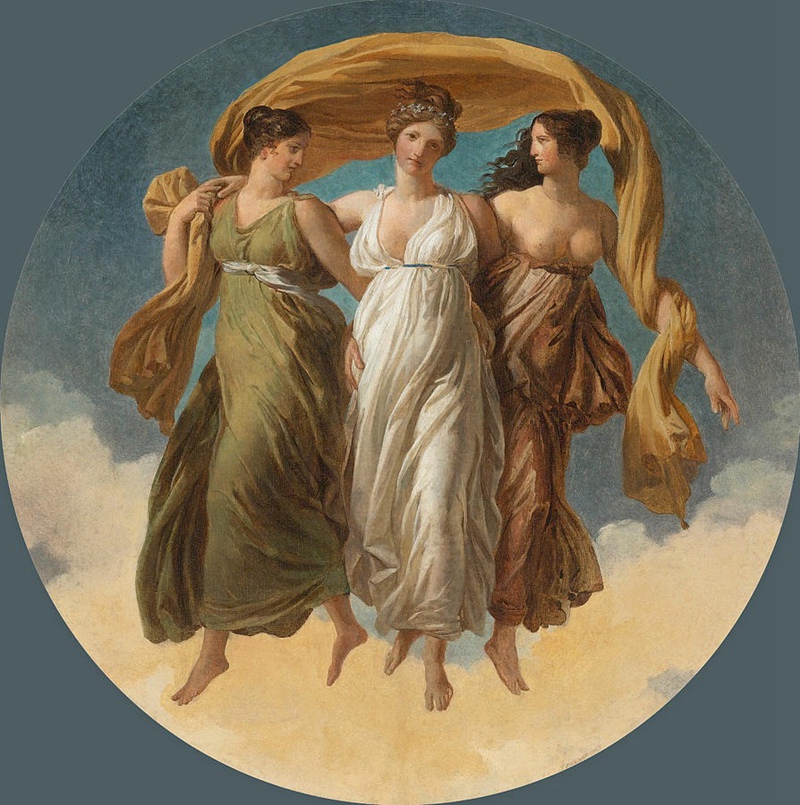
The Three Graces: Aglaea, Euphrosyne, and Thalia, depicted as three elegant goddesses standing together
What Does the Three Graces Statue Symbolize?
The Three Graces statue is generally interpreted as a symbol of beauty, unity and the reciprocal nature of giving.
Beauty and elegance
The balanced poses and flowing lines of the figures express an ideal of physical and artistic beauty. In marble versions, the controlled polishing and soft transitions between light and shadow make the figures appear more lifelike.
Friendship and unity
The figures embrace or rest their hands on one another. Their physical connection conveys trust, companionship and emotional harmony. This makes the sculpture particularly meaningful for private homes, wedding venues and spaces designed for gathering.
Joy and abundance
The Graces were associated with celebrations, banquets, music and the gifts that enrich human life. For this reason, the sculpture can also represent hospitality, prosperity and enjoyment.
Giving and receiving
In ancient and Renaissance interpretations, the circular relationship between the three figures was sometimes understood as an allegory of generosity: one gives, another receives, and the third returns the gift. Their linked composition makes this exchange appear continuous.
Why Is Antonio Canova’s Three Graces So Famous?
Antonio Canova created the most celebrated sculptural interpretation of the Three Graces during the early nineteenth century.
The first marble version was commissioned by Joséphine de Beauharnais, the former wife of Napoleon. After her death in 1814, it passed to her son and eventually entered the collection of the State Hermitage Museum in St. Petersburg.
John Russell, the 6th Duke of Bedford, saw the work in Canova’s Roman studio and commissioned a second version. According to the Victoria and Albert Museum, Canova created this second group between 1814 and 1817. He used white marble rather than the veined marble of the first version and made several adjustments to the figures and supporting column.
The completed sculpture was installed at Woburn Abbey in a specially designed, top-lit room called the Temple of the Graces. It stood on a rotating plinth so that viewers could appreciate the composition from different angles. This history is especially relevant to modern estate and castle projects: the sculpture was conceived not simply as an isolated object, but as the centerpiece of an architectural interior.
Canova’s second version is now jointly owned by the Victoria and Albert Museum and the National Galleries of Scotland.
Source: Victoria and Albert Museum — The Three Graces by Antonio Canova
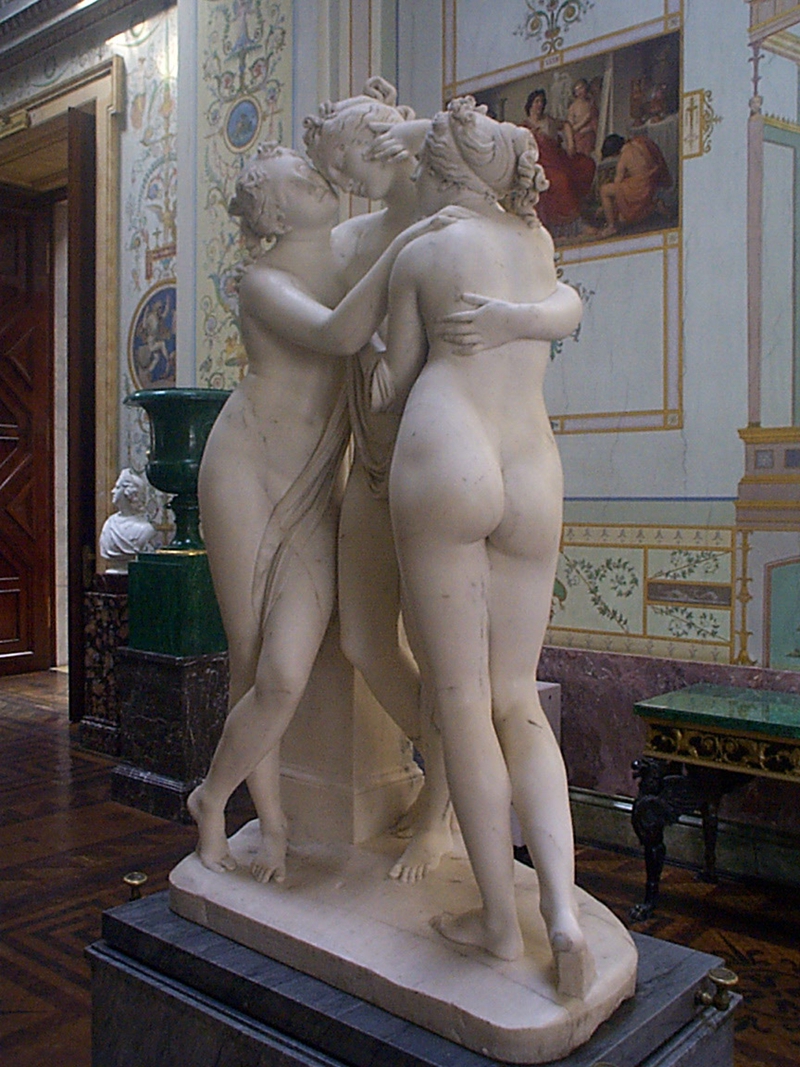
The Three Graces, alternate view, in the Hermitage Museum, Saint Petersburg, Russia
Famous Three Graces Sculptures in Art History
The Three Graces have appeared in sculpture for more than two thousand years. These four examples show how the subject changed across different periods.
The Roman marble group at The Metropolitan Museum of Art
The Metropolitan Museum of Art holds a Roman marble Three Graces group dating to the second century CE. The figures stand in an alternating front-and-back arrangement that became one of the most recognizable formats for representing the Graces.
The Met notes that the composition was widely copied throughout the Roman world and may have decorated a garden or public bath. That historical use helps explain why the Three Graces remain particularly suitable for formal gardens, courtyards and water-centered landscapes.
Source: The Metropolitan Museum of Art — Marble Statue Group of the Three Graces
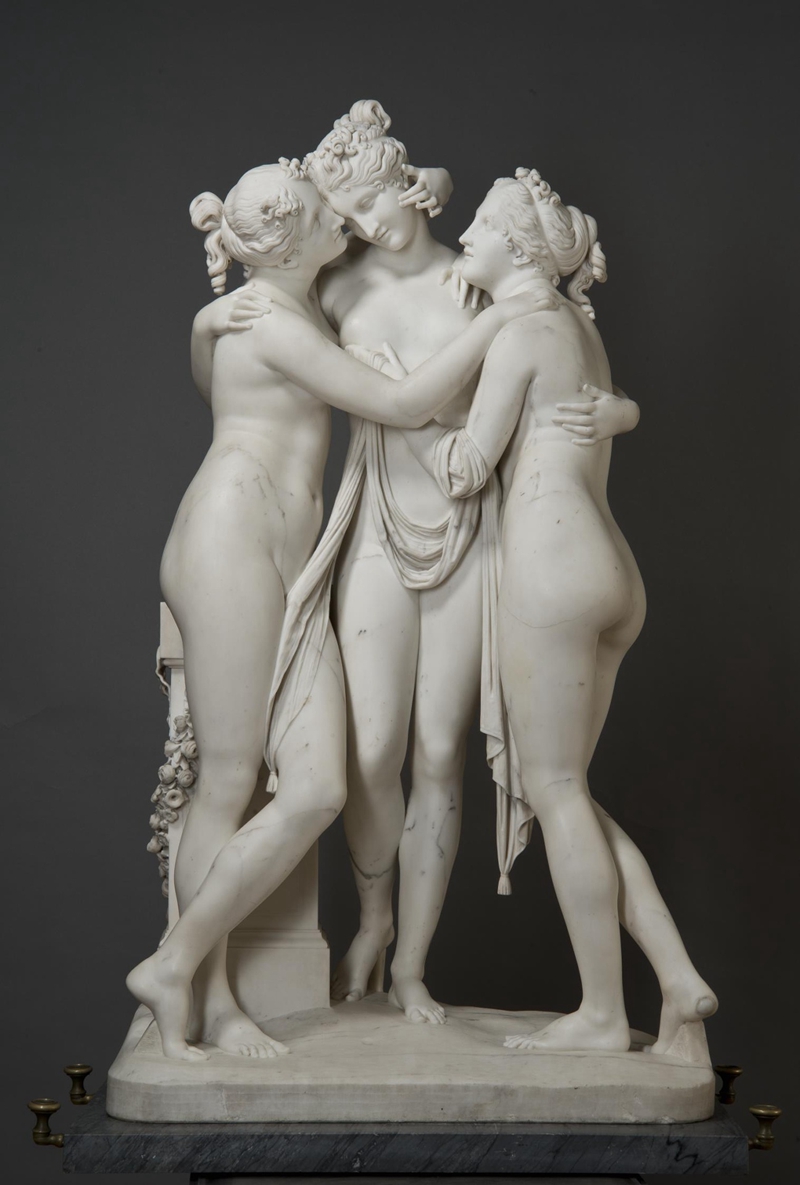
Antonio Canova’s Three Graces
Canova transformed the ancient subject into a close, emotionally connected group. Instead of presenting the three figures primarily as a flat, alternating composition, he brought them together through touch, shared gazes and a continuous line of drapery.
The smooth white marble and carefully controlled poses create the softness and intimacy that made this version an icon of Neoclassical sculpture.
Bertel Thorvaldsen’s Cupid and the Graces
Bertel Thorvaldsen, one of Canova’s leading Neoclassical contemporaries, created his own interpretation between 1820 and 1823. In Thorvaldsen’s composition, Cupid plays a lyre at the feet of the three sisters, making the relationship between beauty, grace, music and love more explicit.
The marble version in the Thorvaldsens Museum measures approximately 172.7 cm high.
Source: Thorvaldsens Museum — Cupid and the Graces
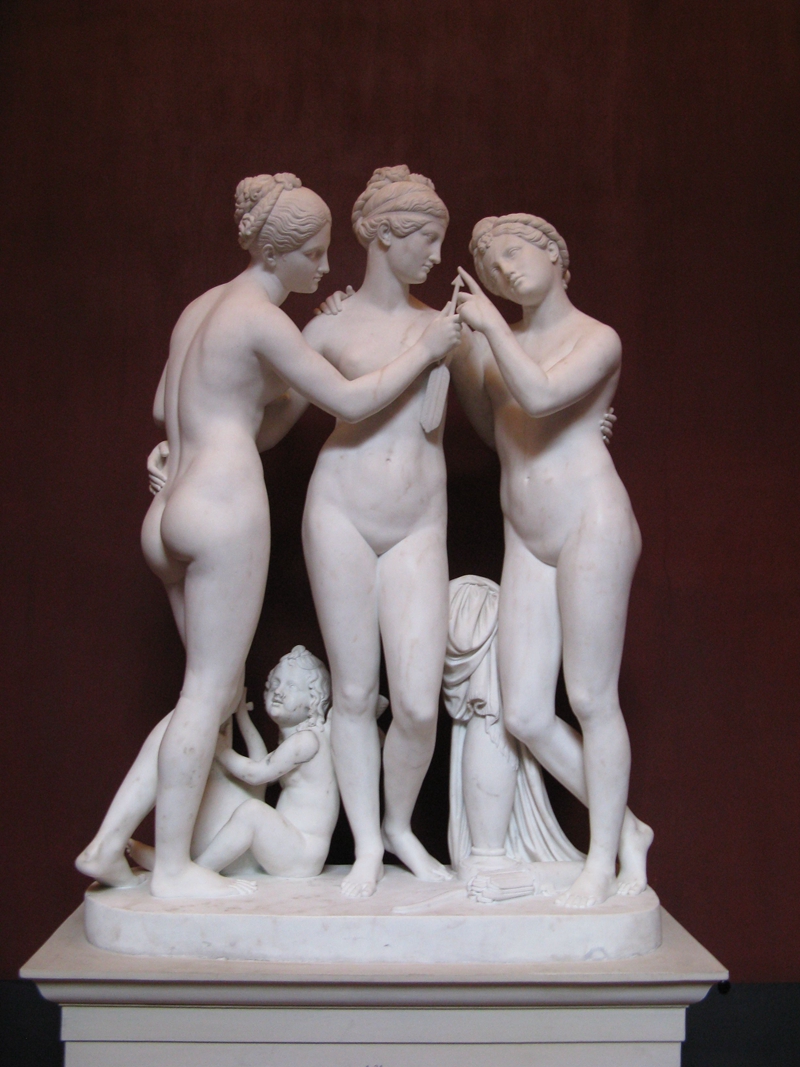
Bertel Thorvaldsen-The three Graces and Cupid-Thorvaldsen Museum
James Pradier’s Three Graces at the Louvre
The Three Graces displayed at the Louvre were created by French sculptor James Pradier in 1831. The group was carved from Carrara marble and measures approximately 172 cm high, 102 cm wide and 45 cm deep.
This is not an ancient Roman group. It is a nineteenth-century work that demonstrates how the subject continued to inspire European sculptors after Canova.
Source: Louvre Collections — Les Trois Grâces
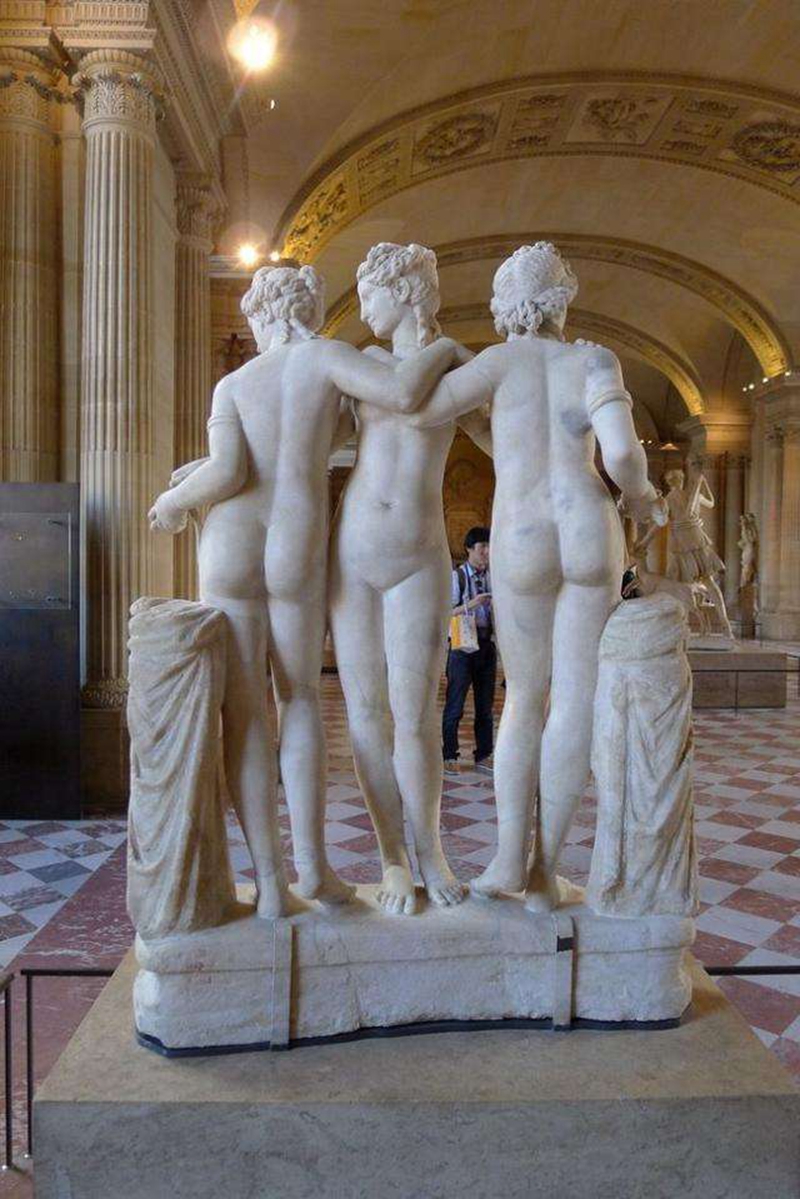
The Three Graces (Louvre)
Why Is White Marble Ideal for a Three Graces Replica?
Natural white marble is particularly well suited to the Three Graces because the composition depends on subtle anatomy, soft facial expressions and closely connected figures.
A suitable block should have a consistent structure and a color that supports the intended architectural environment. A cooler, purer white can complement formal Neoclassical interiors, while marble with gentle natural veining can add warmth and individuality to a garden or historic residence.
During carving, the quality of the marble affects how clearly the sculptor can define delicate areas such as fingers, hair, facial features and the thin drapery connecting the figures. The final surface should not be polished uniformly. Different treatments can be used to distinguish skin, hair, fabric and the base while preserving the visual softness associated with Canova’s sculpture.
For outdoor projects, the marble, pedestal, drainage and fixing method should be considered together. Choosing a sculpture only by its appearance, without planning the foundation and installation, can create avoidable risks later in the project.
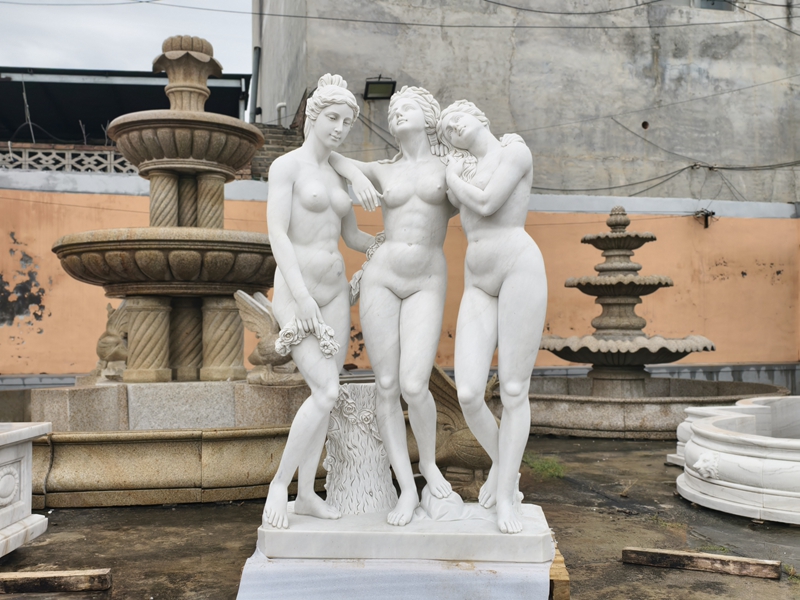
The Three Graces replica
Where Should a Three Graces Statue Be Placed?
A Three Graces statue is designed to be appreciated from more than one viewpoint. The best location therefore provides sufficient space around the sculpture and allows light to reveal the relationship between the three figures.
Estate gardens and formal lawns
On a lawn or at the end of a garden axis, the sculpture can serve as a distant focal point. A raised pedestal improves visibility above planting and helps protect the lower section from soil and standing water.
Castle halls and sculpture galleries
Canova’s sculpture was historically displayed in a purpose-built, top-lit room. In a castle hall, rotunda or gallery, soft natural or directional lighting can reveal the marble’s surface and allow visitors to walk around the group.
Courtyards and villa entrances
A medium or life-size Three Graces group can soften the strong architectural lines of a courtyard. The pedestal should be proportioned to the surrounding doors, columns and sightlines rather than selected separately from the sculpture.
Fountain and pool settings
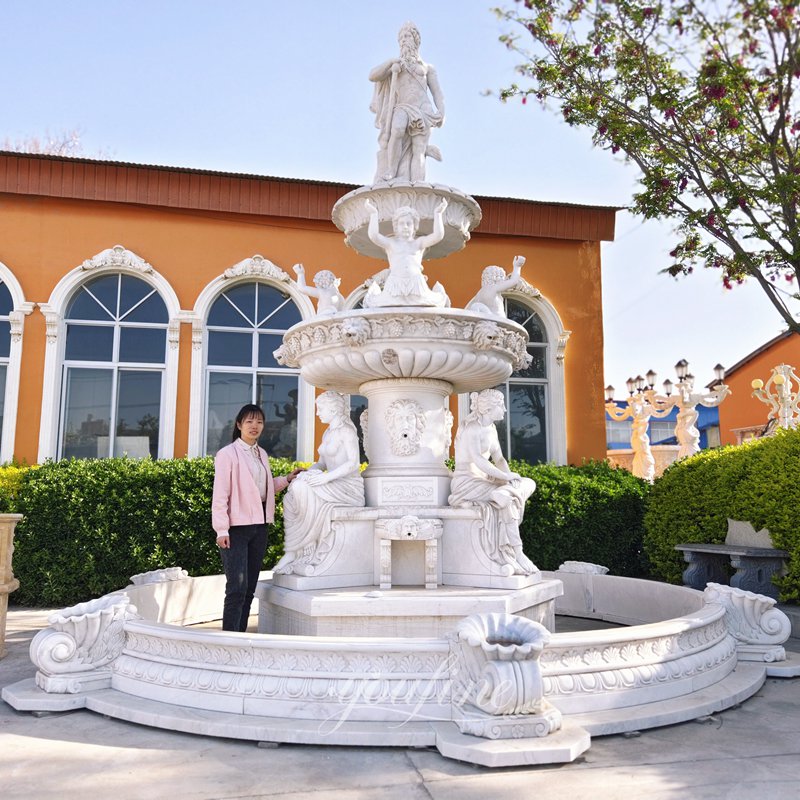
The group can be incorporated into a custom fountain or positioned beside a reflecting pool. If water is part of the design, the basin, drainage, plumbing and long-term maintenance requirements must be planned before carving begins.
Hotels, resorts and wedding venues
Because the sculpture symbolizes beauty, unity and celebration, it is well suited to hospitality and wedding environments. In these settings, the design should also account for guest circulation, photography angles and safe separation from busy walkways.
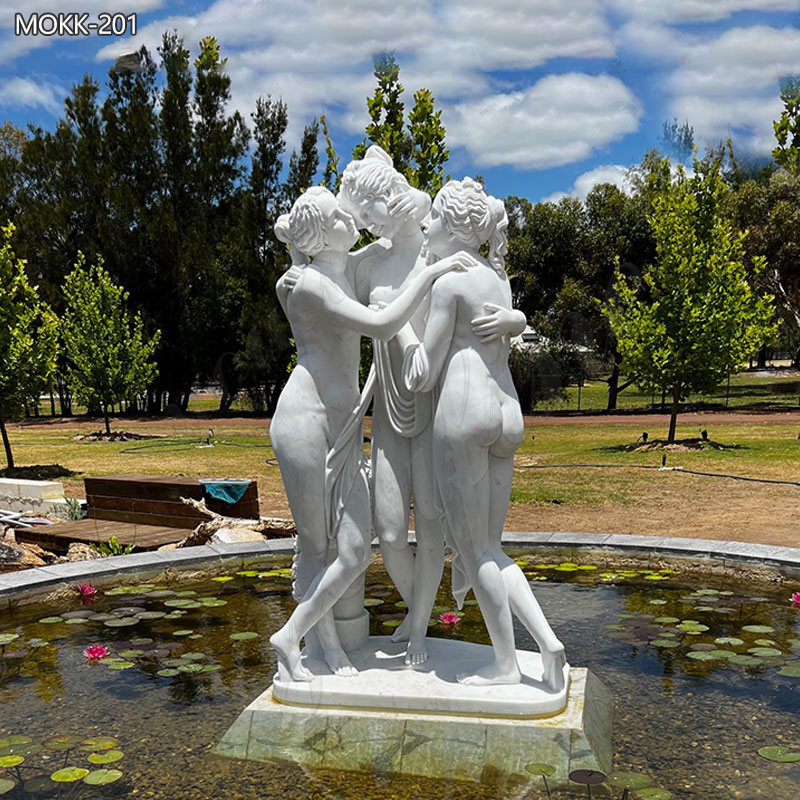
How to Choose the Right Size, Marble and Pedestal
The correct size depends on the architecture and viewing distance, not simply on whether the statue is described as “life-size.”
As a general planning reference:
-
80–120 cm: suitable for intimate interiors, niches and smaller courtyards
-
150–180 cm: appropriate for life-size presentations in halls, gardens and villa entrances
-
200 cm and above: suitable for monumental landscapes, large estates and grand architectural settings
These dimensions are only starting points. The total width, depth, pedestal height and surrounding space must also be evaluated.
Before confirming a commission, consider:
-
Where will the sculpture be installed?
-
From what distance will it normally be viewed?
-
Can people walk around all sides?
-
Will it be placed indoors, outdoors or near water?
-
Does the site require a custom pedestal?
-
How will the sculpture be unloaded and moved into position?
-
Are foundation drawings or fixing points required?
-
Does the marble need to match existing columns, fountains or architectural stone?
For large projects, photographs, architectural plans and site measurements are more useful than choosing a size from a product image alone.
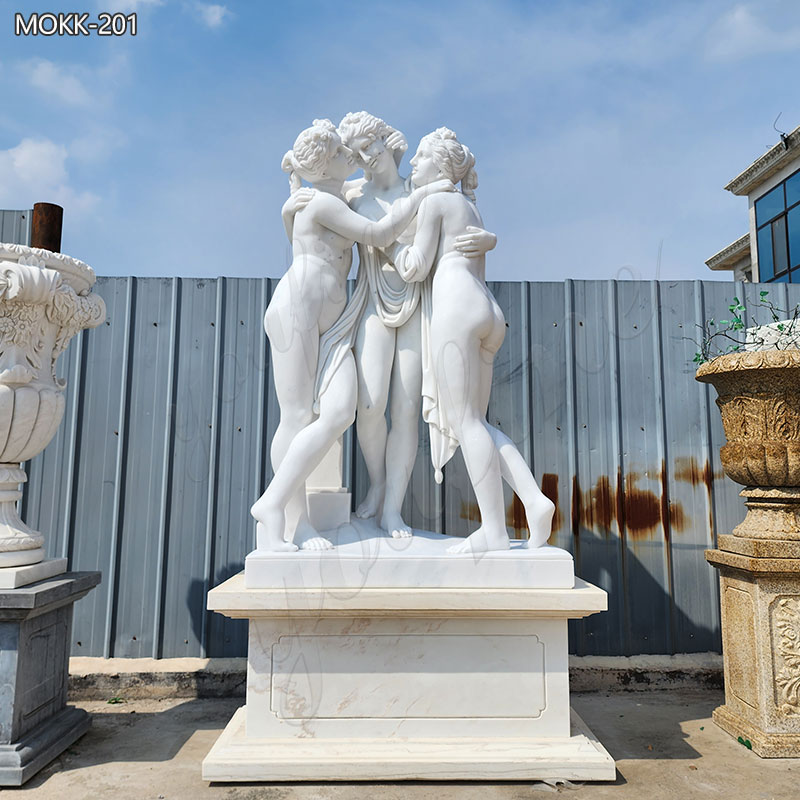

Three Graces Statues for Private Estates and Castles
YouFine has supplied Three Graces sculptures to high-end private clients, including estate and castle owners. Natural white marble was selected for these projects because it complemented their classical architecture, landscaped grounds and interior stonework.
For a private commission, the success of the sculpture depends on more than carving quality. The group must be correctly scaled for its environment, the pedestal must relate to the architecture, and delivery and installation must be planned before production is completed.
When client privacy allows, we recommend showing the following project evidence in this section:
-
A full view of the completed sculpture
-
Close-up photographs of the faces, hands and drapery
-
Images taken during carving and finishing
-
The installed sculpture in the estate or castle
-
Finished height, marble type and pedestal dimensions
-
Client country and installation year
-
A short description of why the client selected the Three Graces
These project details help architects and private buyers evaluate the sculpture more effectively than general statements about quality.
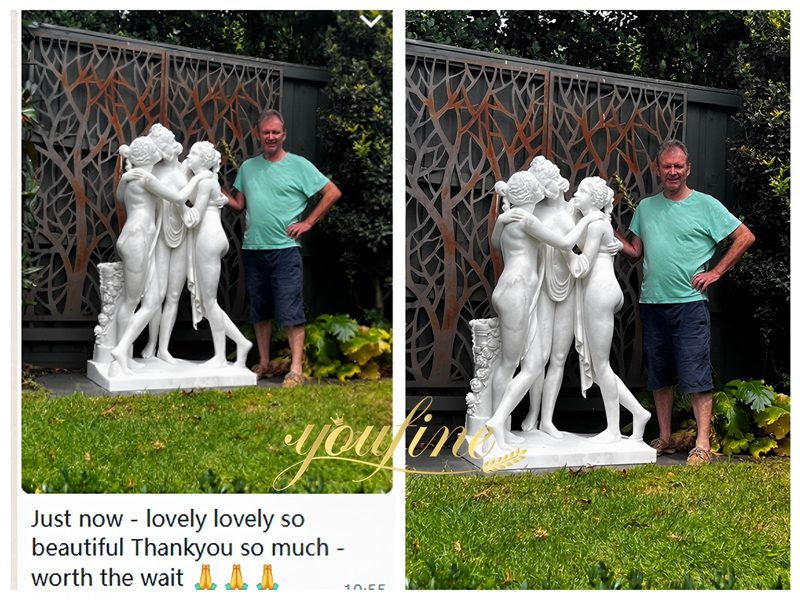
The Three Graces replica clients’ feedback
Frequently Asked Questions
What does the Three Graces statue represent?
The sculpture represents beauty, joy, charm, friendship and harmony. The three linked figures can also symbolize generosity and the continuous relationship between giving, receiving and returning a gift.
Who created the most famous Three Graces statue?
The best-known sculptural version was created by Italian Neoclassical sculptor Antonio Canova. He produced two marble versions during the early nineteenth century.
Where are Canova’s original Three Graces sculptures?
The first version is held by the State Hermitage Museum in St. Petersburg. The second is jointly owned by the Victoria and Albert Museum in London and the National Galleries of Scotland in Edinburgh.
Is a marble Three Graces statue suitable for outdoor use?
Yes. Natural marble has been used for outdoor sculpture for centuries. However, correct stone selection, pedestal design, drainage, fixing and seasonal maintenance are important for long-term outdoor installation.
What size is best for an estate or castle?
Life-size and larger versions are generally better suited to large gardens, castle halls and formal courtyards. The final size should be based on viewing distance, ceiling height, surrounding architecture and the dimensions of the pedestal.
Can the pedestal and sculpture size be customized?
Yes. YouFine can customize the sculpture height, pedestal, marble color, surface treatment and selected design details. Fountain or pool integration can also be considered during the design stage.
How much does a marble Three Graces statue cost?
The price depends on size, marble selection, carving complexity, pedestal design, packaging and destination. A project-specific quotation is more reliable than a single published price. Providing the preferred height and installation location will allow the factory to prepare a more accurate proposal.
How long does production take?
A standard Three Graces marble sculpture generally requires approximately 40–45 days of production. Large-scale versions, customized bases or complex project requirements may require additional time.
Commission a Three Graces Sculpture for Your Project
The Three Graces is more than a classical decorative subject. Its linked figures, balanced composition and symbolism make it a natural centerpiece for spaces designed around beauty, hospitality and architectural harmony.
If you are planning a Three Graces sculpture for an estate, castle, garden, courtyard, hotel or private interior, send YouFine your preferred height, installation photographs and available site dimensions. Our team can recommend an appropriate marble, sculpture scale, pedestal proportion, packaging method and installation solution.
Contact YouFine for project consultation, production details and a factory-direct quotation.
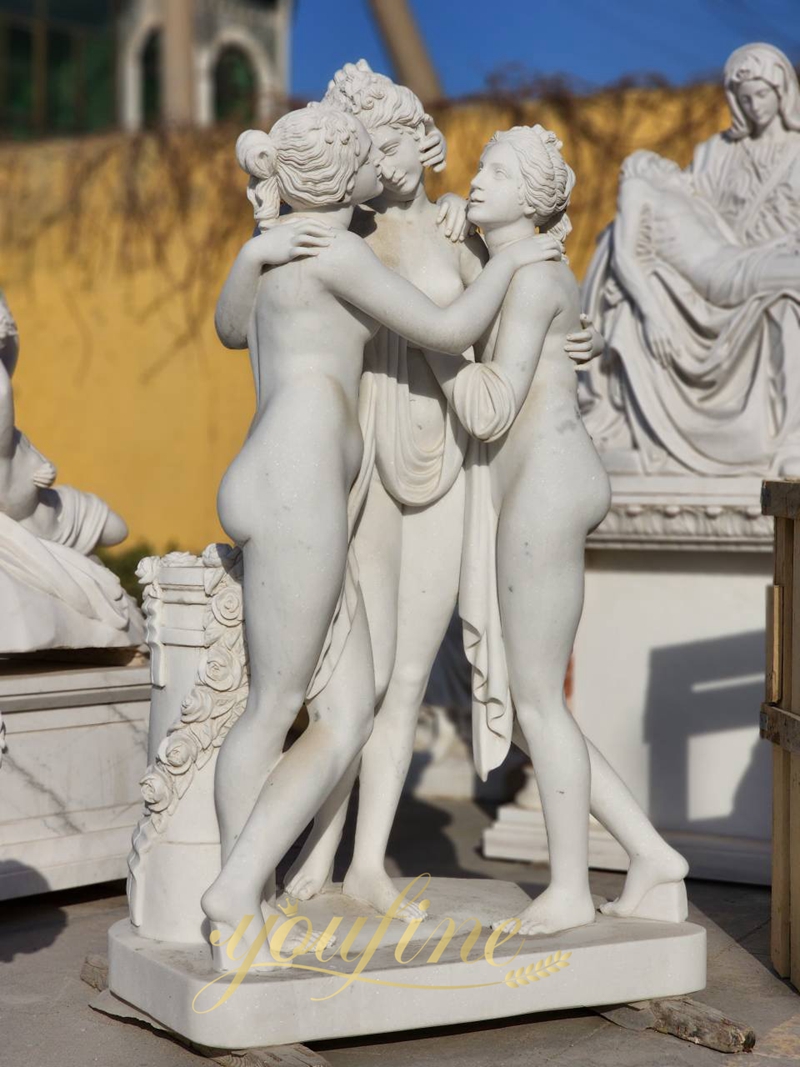
Get the same one: Marble the Three Graces Garden Ornaments for Sale MOKK-211