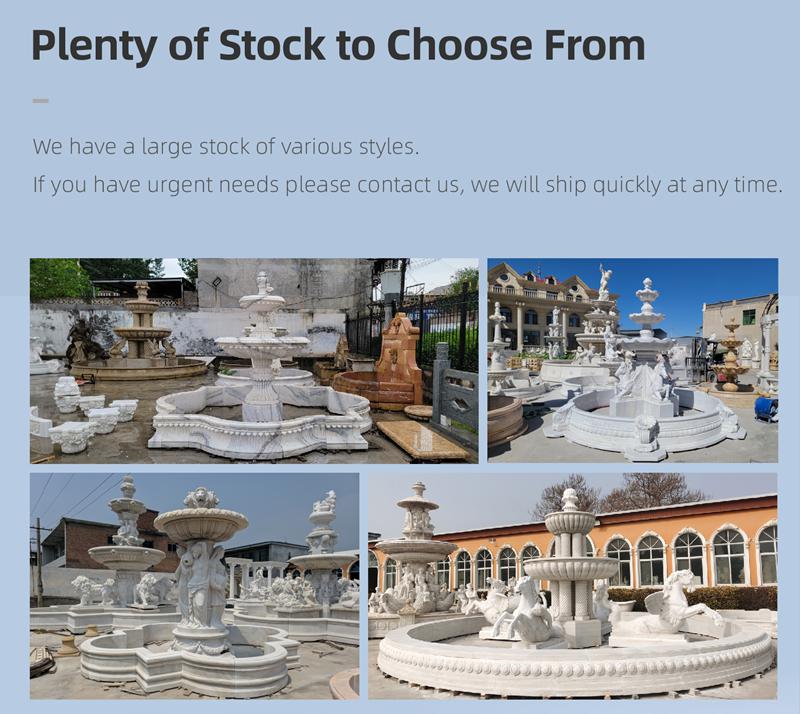




Choosing the diameter of a marble fountain is not only a product-size decision. It is a site-proportion decision. When I help customers evaluate a fountain for a villa courtyard, hotel entrance, resort forecourt, estate garden, or real estate landscape feature, I do not start by asking, “Which photo do you like?” I first look at the space where the fountain will stand.
A beautiful marble fountain can look impressive in one project and completely wrong in another if the diameter does not match the courtyard, pool, building façade, viewing distance, and circulation space. This is why I always recommend confirming the size before production with drawings, dimensions, and site photos instead of relying only on catalogue images.
In this guide, I will explain what “fountain diameter” really means, how the surrounding pool relates to the fountain body, how diameter and height should work together, and what information you should prepare before finalizing a custom marble tiered fountain.
First Clarify: Which Diameter Are You Talking About?
One of the most common sizing mistakes happens because different people use the word “diameter” to mean different parts of the fountain.
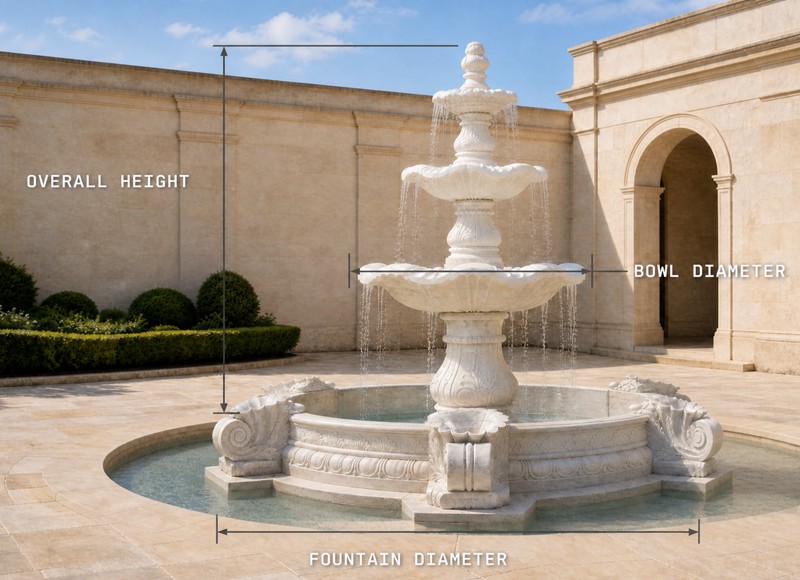
For a marble tiered water fountain, “diameter” may refer to:
| Diameter Term | What It Means | Why It Matters |
|---|---|---|
| Fountain body diameter | The overall width of the carved fountain structure, often including the widest bowl or lower tier | Important for production, packing, installation, and visual scale |
| Largest bowl diameter | The width of the widest tier bowl | Affects water falling effect and visual fullness |
| Base diameter | The width of the lowest supporting base or pedestal area | Important for stability and installation planning |
| Pool or basin diameter | The diameter of the surrounding water pool that receives the falling water | Usually larger than the fountain body diameter |
| Outer landscape diameter | The total occupied area including pool edge, paving, planting, or circulation zone | Important for site layout and pedestrian movement |
The practical point is simple: when you receive a quotation or drawing, you should confirm exactly which diameter is being discussed. If a supplier says “3 meters diameter,” ask whether that means the carved fountain body, the largest bowl, the stone base, or the whole water pool.
This is especially important for custom marble fountains because the surrounding pool is often built on site by the contractor, while the carved marble fountain body is manufactured separately.
The Pool Diameter Is Usually Larger Than the Fountain Body
A fountain should not fill the pool from edge to edge. The surrounding water basin needs extra space for water falling, splash control, maintenance access, and visual breathing room.
If the pool is too tight, even a well-carved marble fountain can look squeezed. Water may splash outside the basin more easily, and the design may lose its elegant layered effect. If the pool is too large for the fountain body, the fountain may look weak or lonely in the middle.
Here is a simple way to understand the relationship:
| Element | Typical Role | Sizing Consideration |
|---|---|---|
| Fountain body | Main carved marble structure with tiers, bowls, column, and statue if included | Should match the site scale and desired visual impact |
| Water pool/basin | Receives water and frames the fountain | Usually needs to be larger than the fountain body |
| Pool edge | Stone, concrete, or landscape border around water | Affects total occupied site area |
| Dry circulation space | Walking or vehicle area around the pool | Must remain comfortable and safe |
I avoid giving one fixed formula because every site is different. However, as a practical rule, the pool should provide enough visible water surface around the fountain so the piece does not look crowded. For a formal courtyard or hotel entrance, the pool diameter often becomes one of the main design references, not an afterthought.
Before ordering, I suggest confirming both:
- The carved marble fountain body diameter
- The surrounding pool or basin diameter
These two numbers should be reviewed together.
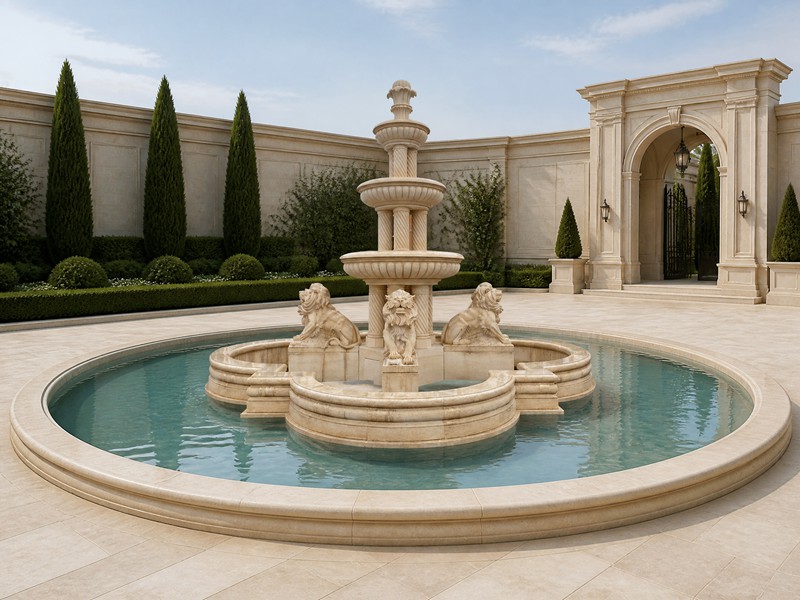
Source: Large Egyptian Marble Lion Statue Fountain
Start with the Site Proportion, Not the Product Photo
Product photos are useful for style selection, but they can be misleading for size selection. A fountain photographed alone in a factory yard or garden may look large because there is no building façade, vehicle driveway, or wide plaza beside it. The same fountain may look small in front of a hotel entrance or too large in a compact villa courtyard.
When I evaluate diameter, I usually think through these site relationships:
| Site Factor | What to Check | Why It Affects Diameter |
|---|---|---|
| Courtyard or plaza width | Total open space where the fountain and pool will sit | Prevents the fountain from looking too small or overcrowded |
| Building entrance scale | Door height, façade width, columns, stairs, and canopy | Helps the fountain match the architecture |
| Viewing distance | Main point where people first see the fountain | A longer viewing distance often needs stronger visual presence |
| Visual axis | Whether the fountain sits on a central line from gate to entrance | A central feature usually needs more balanced proportions |
| Traffic and walking route | Cars, pedestrians, service paths, and turning radius | Prevents the pool from blocking circulation |
| Pool or basin size | Existing or planned water feature dimensions | Determines the maximum practical fountain body diameter |
The key is to imagine how the fountain will be seen in the real environment. A villa owner may view it from the front gate, balcony, or main entrance. A hotel guest may see it from a vehicle arrival lane. A resort visitor may approach it across a broad forecourt. Each viewing condition changes the suitable diameter.
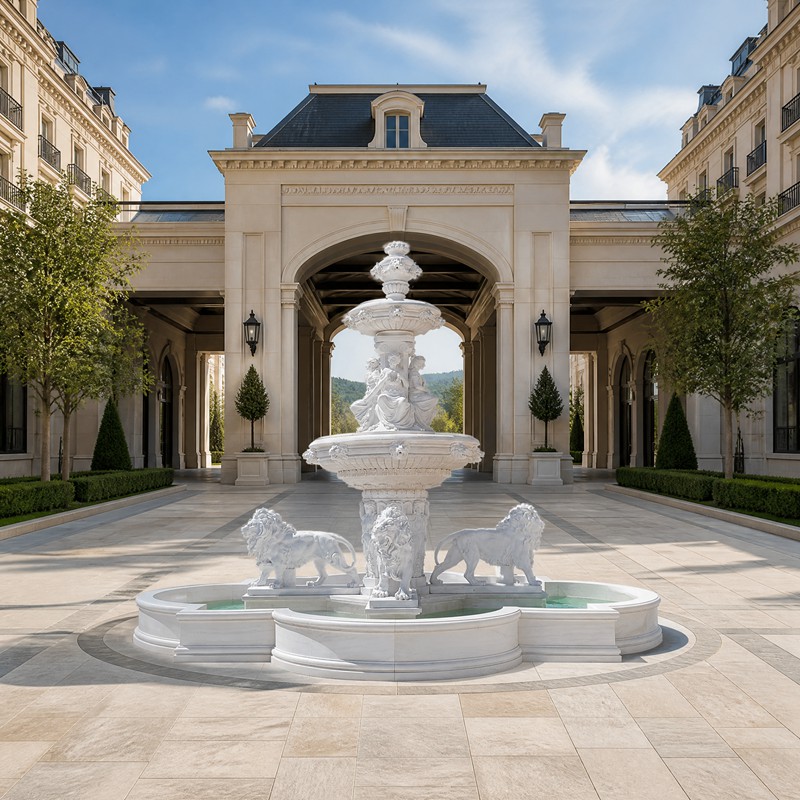
Soutce: Marble Lion Outdoor Fountain with SittingWomen for villa
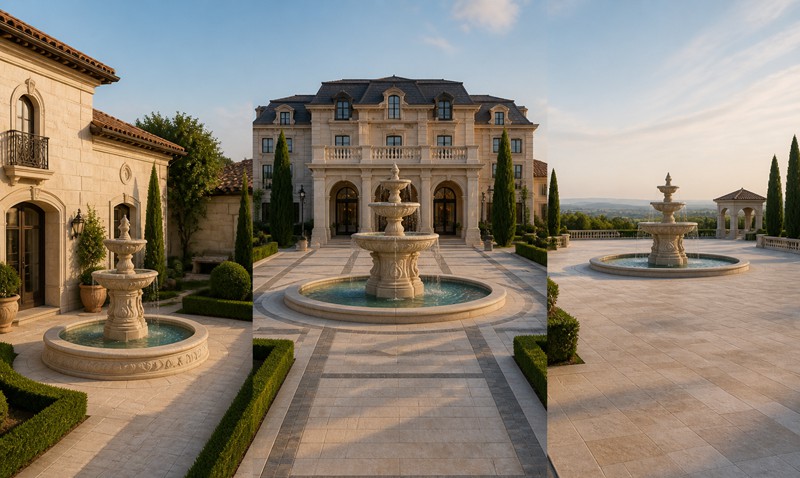
Experience-Based Diameter Ranges by Site Type
A practical recommendation can begin with experience-based diameter ranges, but these should never replace drawing review. The following table is only a starting reference to help you think about scale.
| Site Type | Common Visual Goal | Diameter Thinking |
|---|---|---|
| Small villa courtyard | Elegant center feature without crowding the space | Choose a fountain body diameter that leaves generous walking space and a balanced pool |
| Medium villa or estate courtyard | Stronger central focus with formal symmetry | Match the fountain to the courtyard width, entrance axis, and pool size |
| Hotel entrance plaza | High-visibility landmark for arrival experience | Diameter should be checked against façade scale, driveway layout, and viewing distance |
| Resort forecourt | Decorative focal point with relaxed landscape effect | Consider both close-up detail and distant visibility |
| Castle-style or estate garden | Classical, grand, layered visual effect | Diameter and height should support a formal architectural presence |
| Real estate landscape feature | Memorable project image and sales-area attraction | Coordinate fountain diameter with master plan, pedestrian flow, and photo viewpoints |
A larger fountain is not always more impressive. If it occupies too much of the courtyard, blocks natural movement, or visually fights with the entrance, the space may feel heavy. On the other hand, an undersized fountain in a wide hotel plaza may look like a decoration instead of a landscape centerpiece.
For this reason, I prefer to suggest a reasonable range first, then adjust it after checking the actual site drawings and photos.
Diameter and Height Must Work Together
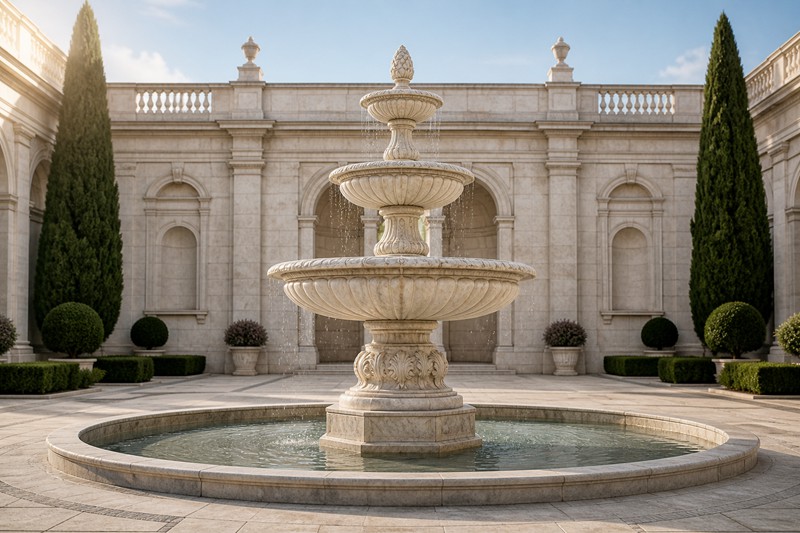
Many customers ask about fountain height first. Height is important, but it cannot decide the diameter alone. A tiered fountain is a three-dimensional object. Its width, height, bowl size, column thickness, base scale, and water effect all need to feel balanced.
If a fountain is tall but too narrow, it may look visually unstable or thin. If it is wide but too low, it may lose the elegant vertical rhythm expected from a classical tiered marble fountain.
Here is how I usually explain the relationship:
| Proportion Issue | Possible Visual Result | What to Review |
|---|---|---|
| Tall and narrow | May look weak, unstable, or too thin for a large site | Bowl diameter, column thickness, base width, façade scale |
| Wide and low | May look heavy or lack vertical elegance | Tier count, central column height, top statue or finial |
| Large pool with small fountain | Fountain may look lost in the basin | Fountain body diameter and water spread |
| Small pool with large fountain | Layout may feel crowded and splash risk may increase | Pool diameter, edge clearance, circulation |
| Large façade with small fountain | Fountain may disappear visually | Entrance width, viewing distance, overall height |
| Small courtyard with oversized fountain | Space may feel blocked or overfilled | Walking route, pool edge, usable area |
For custom production, it is also important not to enlarge or reduce a fountain design freely without proportion review. Marble fountain components must look balanced after scaling. Bowl thickness, carving details, support structure, and water performance all need attention.
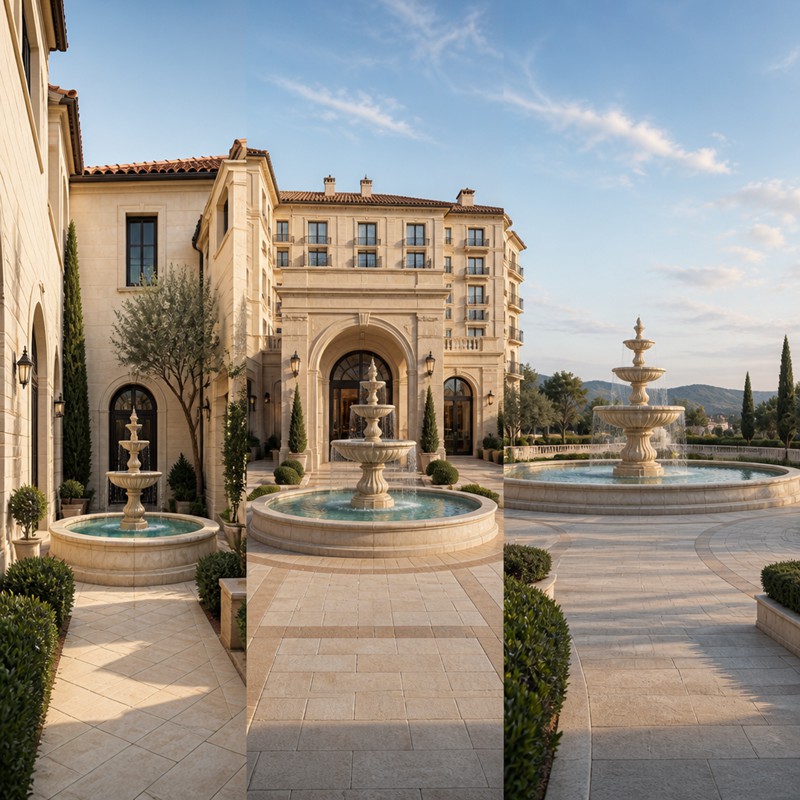
Do Not Copy a Size from Another Project Without Checking Your Site
It is natural to ask, “What size did another customer use?” Project references can be helpful, especially when the architecture and site size are similar. But I do not recommend copying another fountain diameter directly.
Two projects may use the same fountain style but need different sizes because of:
- Different courtyard widths
- Different entrance heights
- Different pool diameters
- Different viewing distances
- Different paving and planting layouts
- Different pedestrian or vehicle routes
- Different desired visual effect
A fountain that looks perfect in a narrow private courtyard may look too small in a resort entrance. A fountain designed for a broad estate garden may overwhelm a residential driveway court.
Reference photos are best used together with site drawings. If actual project comparison photos are available, they can help you understand how a fountain feels in real space. But the final diameter should still be checked against your own layout.
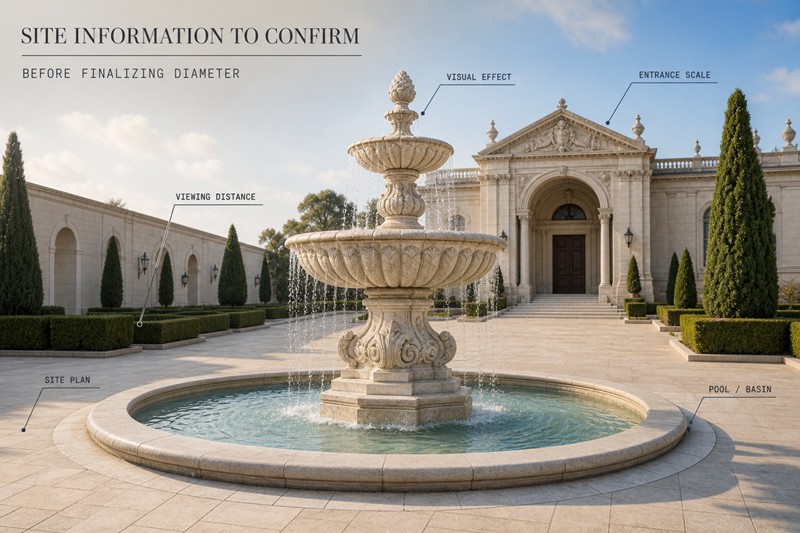
What Site Information Should You Confirm Before Finalizing Diameter?
Before production, I suggest preparing clear site information. This makes the diameter discussion much more accurate and helps avoid misunderstandings.
1. Site Plan Dimensions
A basic plan drawing should show the available courtyard, plaza, garden, or entrance area. Important dimensions include total width, length, centerline, nearby steps, walls, driveways, and planting zones.
If there is already a planned pool, include its inner diameter and outer edge diameter.
2. Pool or Basin Dimensions
If the pool will be built separately on site, the fountain supplier and contractor need to coordinate. The pool diameter, water depth, edge design, and pipe position all affect the final fountain layout.
At minimum, confirm:
| Pool Information | Why It Matters |
|---|---|
| Inner pool diameter | Determines available water surface around the fountain |
| Outer pool diameter | Shows total occupied area in the landscape |
| Pool edge width | Affects visual weight and walking space |
| Water depth | Helps with pump and installation planning |
| Pipe location | Must match the fountain center and water system |
| Drainage and maintenance access | Important for long-term use |
3. Building Façade or Entrance Proportion
For a fountain placed in front of a villa, hotel, clubhouse, or sales center, the building elevation matters. A small fountain may look weak against a tall entrance with columns. A very large fountain may block the view of an elegant doorway or façade.
Useful references include entrance width, door height, stair width, column scale, canopy size, and the distance from fountain center to entrance.
4. Main Viewing Distance
The main viewing distance is where people first see the fountain. It may be the gate, driveway entrance, hotel drop-off point, garden path, or balcony.
A fountain viewed from far away may need a larger diameter or stronger height to read clearly. A fountain viewed mainly from close range may need more attention to carving detail, water sound, and comfortable circulation space.
5. Desired Visual Effect
Some customers want a graceful classical centerpiece. Others want a grand landmark. Some prefer a low, wide water effect; others prefer a tall tiered design with a statue or finial.
The desired feeling should be matched with actual site space. I always try to connect the customer’s visual goal with practical size limits.
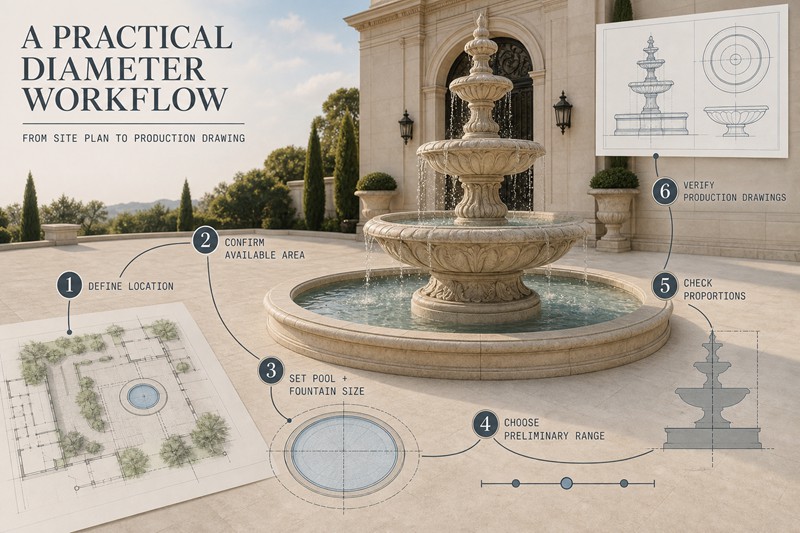
A Practical Step-by-Step Method to Choose the Diameter
If you are at the early decision stage, I recommend this process.
Step 1: Define the Fountain Location
Mark the exact center point of the fountain on the site plan. Confirm whether it is on a central visual axis, inside a roundabout, in a garden pool, or in front of an entrance.
Step 2: Confirm the Total Available Area
Measure the complete area available for the fountain, pool, pool edge, and walking or vehicle circulation. Do not use all the open space for the pool. The surrounding space is part of the design.
Step 3: Decide the Pool Diameter First or Together with the Fountain Body
If the landscape plan already includes a pool, check whether the fountain body can sit comfortably inside it. If the pool is not yet designed, decide the pool and fountain body diameter together.
Step 4: Select a Preliminary Fountain Body Diameter Range
Based on the site type, pool size, viewing distance, and visual goal, choose a preliminary range. At this stage, do not treat the number as final. It is a working size for discussion.
Step 5: Check Height and Diameter Proportion
Review whether the tier count, height, widest bowl, base, and pool look balanced together. If a top statue is included, check whether it changes the overall visual height.
Step 6: Confirm Production Drawing Details
Before placing the final order, confirm the drawing clearly labels the fountain body diameter, largest bowl diameter, base diameter, and pool/basin diameter if included. This prevents confusion between the carved marble item and the site-built water basin.
Common Mistakes to Avoid
The wrong diameter often comes from a simple but expensive misunderstanding. These are the mistakes I recommend avoiding:
| Mistake | Why It Causes Problems | Better Approach |
|---|---|---|
| Choosing only from photos | Photos often lack scale references | Compare the design with site drawings |
| Treating pool diameter as fountain diameter | The fountain body and basin are different objects | Confirm each diameter separately |
| Choosing only by height | Height alone does not create balanced proportion | Review width, height, pool, and site scale together |
| Assuming bigger is always better | Oversizing can block circulation and overpower architecture | Match size to site proportion |
| Copying another project directly | Similar fountains may sit in very different spaces | Use references only after checking your own layout |
| Ignoring viewing distance | A fountain may look different near and far | Check the main visual axis and approach route |
A fountain should feel intentional in its setting. Good proportion is usually the result of careful checking, not guesswork.
Frequently Asked Questions
1. What does marble fountain diameter usually mean in a quotation?
It depends on the supplier’s wording, so you should always ask. In many cases, it may mean the carved fountain body diameter or the widest bowl diameter. It may not include the surrounding pool. Before ordering, I suggest confirming the fountain body diameter, largest bowl diameter, base diameter, and pool diameter separately.
2. Should the water pool be larger than the fountain body?
Yes, in most outdoor tiered fountain layouts, the water pool or basin should be larger than the fountain body. The extra space allows for falling water, splash control, visual breathing room, and better proportion. The exact difference should be checked with the fountain design and site layout.
3. Can I choose fountain diameter based only on total height?
No. Height is only one part of the proportion. A tall fountain that is too narrow may look weak, while a wide fountain that is too low may look heavy. Diameter, height, bowl size, base width, pool size, and viewing distance should be reviewed together.
4. What information should I send before asking for a size recommendation?
The most useful information includes the site plan, available area dimensions, planned pool diameter, entrance or façade photos, main viewing distance, and desired visual effect. If you already have a landscape drawing, send that first. It helps me suggest a more reasonable diameter range.
5. Is one standard marble fountain size suitable for most villa courtyards?
No. Villa courtyards vary greatly in width, entrance scale, paving layout, and circulation needs. A standard catalogue size may be a useful starting point, but the final diameter should be confirmed against your actual site.
6. Can a marble tiered fountain design be enlarged or reduced freely?
Not always. Scaling a marble fountain affects bowl proportion, carving detail, stone thickness, support, water effect, and visual balance. A custom size should be reviewed carefully before production drawings are finalized.
In Conclusion
To determine the diameter of a marble tiered water fountain, start with the site, not the product photo. Clarify which diameter you mean, compare the fountain body with the pool diameter, review the courtyard or plaza proportion, and check how the height and width work together.
The best size is not simply the largest size you can buy. It is the size that looks natural, balanced, and impressive in your specific space. For a villa courtyard, it should feel elegant without crowding the area. For a hotel or resort entrance, it should have enough presence without disturbing circulation or overpowering the architecture.
Before confirming a custom marble fountain order, I recommend checking three points carefully: the site drawing dimensions, the expected visual effect from the main viewing distance, and the exact diameter being quoted or customized.
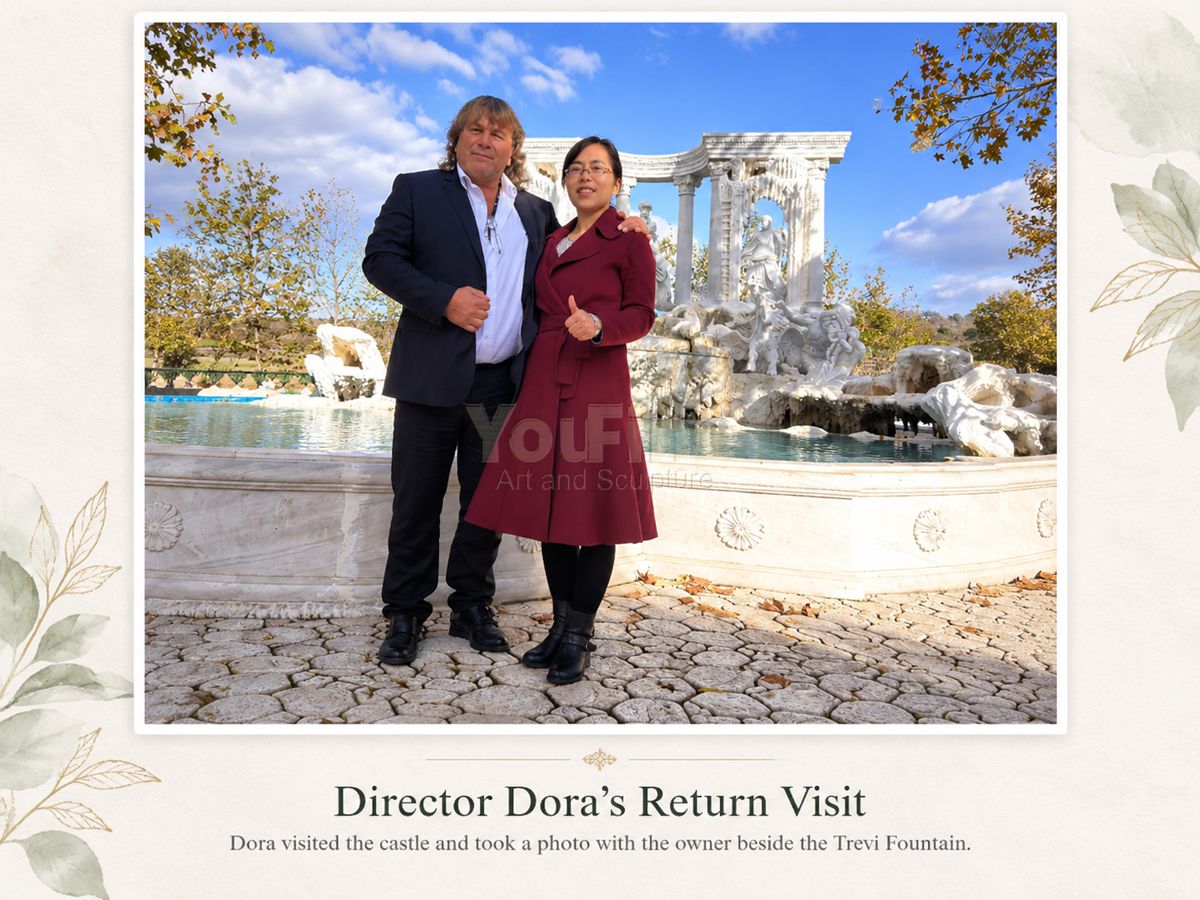
If you are planning a marble tiered water fountain for a villa, hotel, resort, estate, or real estate landscape project, you can send your site drawings, pool dimensions, entrance photos, courtyard photos, or project layout to You Fine Art Sculpture. I can help review the information and suggest a suitable fountain diameter range before production.